|
Biographies of Our Forefathers
PATRICK "WEE PAT" TINNENY
BY
RICHARD J. TINNENY
Patrick
was the second child of James Tinneny and Mary Ann McEntyre.
He was born at Goladuff on Saint Patrick's Day, March 17,
1895. He was known as "Wee Pat" because he was small
compared with and to distinguish him from his older first
cousin Patrick, the son of his Uncle Francis.
When
Patrick was about 9 years old his grandfather McEntyre, who
had a farm in Derrykerrib, came one day to get Patrick to
help him make hay. Patrick's mother, Mary Ann, said that he
could not go to help since he did not have a shirt. After
some time she got him a shirt and he went off with his
grandfather. From that day forward Patrick lived with his
grandparents and never returned to live at Goladuff.
Pat was
raised by his grandfather McEntyre on his farm at
Derrykerrib and went to Drumlane School. When his
grandfather died he left the house and farm at Derrykerrib
to Patrick. Because of his IRA involvement Pat couldn't
settle down and didn't want the house and land. He never
really used it and the house and land fell into disrepair.
As
mentioned above, Pat was very active with the IRA. As one
of their soldiers, one night in 1920 he and his brother Ned
participated in a raid on Castle Sanderson to obtain guns.
The night of the raid there was a big party going on at the
castle. The raiders took hostage the estate’s gamekeeper, a
fellow named McCaully, who lived on the grounds.

Holding a
knife to McCaully's throat, they knocked on the door of the
castle and had McCaully request the door be opened so that
he could come in. The doorkeeper recognized his voice, the
door was opened and the raiding party rushed in. They lined
all of the party attendees and the Colonel's staff up
against the walls. Then they began a search for weapons to
confiscate. Pat told about going to the Colonel's bedroom
and finding that the walls of the room were completely
surfaced with mirrors. However, they only found two guns,
one double-barreled shotgun and a pistol.
Pat
Tinneny. Photo Courtesy of Maisie Tinneny Brady.
When they
returned to the gathering of people in the room where the
party was taking place two of the girls employed at the
castle whispered to the raiders to check the cellar. They
went to the cellar and found many guns, which they took for
use in support of IRA activities.
The day
following the raid the two girls that tipped off the raiding
party as to the location of the guns were found out and sent
away from the estate. "Wee John" Mullin, who was a Garda
(policeman) and apparently a sympathizer found them another
place to work.
At the
time of the raid Robert Tinneny was a boat builder and
carpenter for Colonel Sanderson. Bob was loyal to the
Colonel and he and his family lived in a small house on the
estate. Bob probably had no idea that his cousin Pat
Tinneny was a member of the raiding party that night.
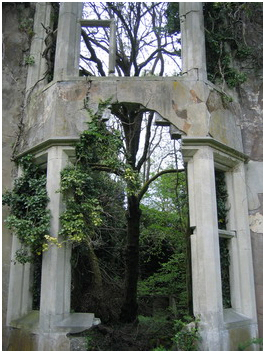
The local population
learned that the British were sending in a unit of the
notorious Black and Tans to occupy the Lanesborough estate.
As a reaction to this the IRA attacked the estate and blew
up the main house which has never been rebuilt.
The
following account about the Ballatrain barracks raid in
which Pat and his brother Ned participated appeared on page
6 of The Impartial Reporter on February 19, 1920:
More Outrages in
Ireland
Murders in Co. Wexford
Co. Monaghan Barracks
Attacked
Robberies of Mail Cars
Police Besieged
One of the daring raids
for arms, which has taken place in Ireland occurred on
Sunday morning on the police barracks in Ballatrain, a
village near the boarders of Counties Monaghan and Cavan.
The encounter between 150
armed men and the six policemen defending the station was of
the most desperate kind. At five o'clock, when the
policemen refused to surrender, the raiders blew in the side
of the barracks, took all the arms, ammunition, and bombs
from the station and made off.
Four of the men defending
the barracks were buried in the debris and had to be removed
to Carrickmacross Hospital.
Bellatrain is a small
village, and the barracks there was manned by Sergeants
Lawton and Graham, Constables Roddy, Gallagher, Nelson and
Murtagh.
At two o'clock on Sunday
morning when the men were all in bed noise of breaking glass
and the barking of dogs attracted their attention. Hastily
rising, the police proceeded to take steps in the ...
defense because it was clear that an attack was being made
on the building. Bullets were peppering on the outer walls,
and police at once returned fire.
For three hours a
desperate struggle took place. The raiders threw hand
grenades and the police replied with similar weapons.
Hundreds of rifle shots had been exchanged when at 5 o'clock
the leader of the attacking party demanded the surrender of
the barracks, but the police continued to shoot.
Afterwards a terrific
explosion took place, which blew in the gable of the
barracks, throwing the bedsteads and other articles through
the walls, wrecking them and scattering sandbags on the main
road.
About 150 men armed with
rifles and revolvers, and all wearing masks, entered through
the breach and demanded the rifles and ammunition in the
station. They opened all the boxes and took away six
revolvers, four ordinary pistols, an automatic pistol, a 'Verey'
pistol, a quantity of ammunition and 12 hand grenades.
Sergeant Lawton and
Constables Roddy, Murtagh, and Gallagher were removed to
hospital, their injuries having been caused by the falling
of the wall.
Sergeant Graham,
interviewed said he had only been three days in Bellatrain,
and had been on special duty in Tipperary before that. He
estimated over 100 shots were fired by the raiders before
any bombs were thrown. After that an explosion occurred at
least 50 men came in and demanded surrender of the place.
With four of his men down the sergeant could do nothing
else. The leader of the raiders said he was glad that no
one was killed. The sergeant asked if they had a doctor and
the reply was that they had not. Sergeant Graham was
compelled to walk nine miles to Carrickmacross for a
doctor. He had attempted to drive, but the road was blocked
with felled trees and an iron gate was placed in the center
of the roadway.
Constable Roddy who is in
hospital suffering from injuries, said that when the raiders
entered the station, he told them he had 60 [pounds] in his
box, and asked them not to touch it. The leader said ' We
do not want your money. It's too much money we have.'
Constable Gallagher said
the leader of the raiders had given his orders through a
megaphone, and called the raiders in numbers. During the
attack the police heard much whistling, and before the gable
fell in three very long whistle sounds were given.
Another more extensive
account appeared in The Anglo Celt newspaper on
February 21, 1920.
Another story
about Pat was that he had a friend named was Jack Tummin who was
afraid of bulls. Pat knew that Jack took a short cut across Jack
Grogan's field in Killylea. One night Pat got a white sheet and
laid down with it over him in the dark field. When Jack was well
into the field, Pat jumped up with the sheet over him and chased
Jack, who thought surly that it was a bull.
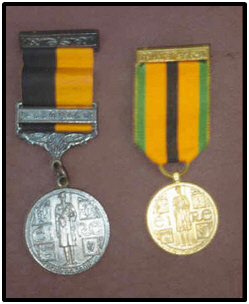
Photo: Medals
awarded to Pat by the Irish government for his service with the IRA
by R. J. Tinneny.
Pat was a great
footballer and played Gaelic football on the Ulster Finals Team in
the town of Clones one year.
Pat was a roof
thatcher by trade. He thatched the roofs of many of the houses
around Belturbet and Newtownbutler. His notoriety as a thatcher was
such that many years after his death he was mentioned in a local
folk song written by Sean McElgunn.
The song
goes like this:
THE SONG OF THE FLAX
| On
the twenty-second of August in the year
of Forty-four, |
|
| I got an
invitation to join the Flying core; |
| We were
supplied with rations and we had the best of fun
- |
| We were
pulling flax in Creeny for Willy McElgunn. |
| |
| We had
recruits from Grilly - likewise the Urban too, |
| There was
Morrissey the Ganger and Johnny McAroo; |
| There was
Tinneny the thatcher, and the Collier in his
hair, |
| And Frank
McConnell and the son were the first two I met
there. |
| |
| From
Derryerry came McCaul, and Mick and Patrick too, |
| And Jemmy
came with buster, some carting for to do; |
| And Master
Sean assisted him with Bobby in full style, |
| And the
juveniles collected beets and laid them in a
pile. |
| |
| I can't
forget McMahon - he's a comic through and
through, |
| But he
couldn't beat your man Kenna, when he got a pint
or two; |
| And Jemmy
Lawler, he was there - a daling man by trade, |
| And
McGovern from Shancorry - some lovely beats he
made. |
| |
| Drumlane
was represented - but only by a man - |
| The Yanky
Charley sent John Fitch to give a helping hand; |
| I hope I'm
missing no one - for I don't want any blame - |
| And Tommy
Cooney, he was there, an old hand at the game. |
| |
| I can't
forget the women - the catering it was grand, |
| To help
the Missus of the house the O' Reillys gave a
hand; |
| For
handing out the sandwiches Miss Bridgie was in
charge, |
| And,
Rosie, she gave bread-and-jam to everyone at
large. |
| |
| When we
had all secured and sodded the dam, |
| Says
Corrigan, "Come on, my boys, we'll go and have a
dram." |
| So we
started for the city where we drank and sang,
you know, |
| Good old
songs like Pat O'Donnell and The Glen of Aherlo. |
| |
| [By]
Sean McElgunn |
Kathleen Fitzpatrick
told me about an incident that occurred one day when Pat was
thatching the roof on her house. Kathleen lived on a small
farm next to Hubert Tinneny in Quivvy. She recalled that
Pat was up on the roof and that her husband Aiden was not at
home when a gypsy came to the door. The gypsy was making
demands on Kathleen thinking she was home alone. She
repeatedly asked him to leave and he wouldn't. Finally, she
called out "Pat". The gypsy, who thought that she was
bluffing and that there was no one else in the house, was he
surprised! Suddenly Pat Tinneny appeared in the doorway of
the house. He was a fearsome sight. He was darkly tanned,
bald, naked from the waste up with his thatching knife in
his teeth. At seeing this savage looking man standing in
the doorway the gypsy ran off.
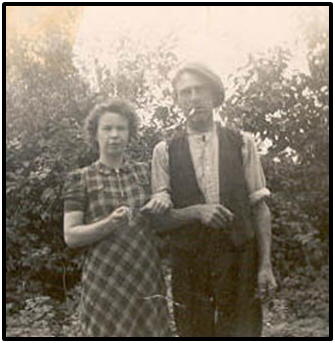
Pat lived in the home
of Benny Wallace at Derryerry near Quivvy for some time. In
a conversation with her in 1994, Kathleen Fitzpatrick Bawn
O'Sullivan remembered Pat well during the time he lived with
the Wallaces. At the time, she was a young girl and neighbor
of the Wallaces. She recalled how Pat cared for young Brian
Wallace, Benny's nephew, and his friends including her
brother Philip Fitzpatrick and herself.
Photo
Pat when he lived with the Wallace family.
Courtesy of Wallace family member.
By all
descriptions Pat was loved by the children. Kathleen
remembered that he had a great sense of humor and many funny
sayings. One day he told her "Don't ever eat duck eggs -- I
just found a frog leg in one." Another of Pat's sayings to
the children, he used when he and the children were caught
by a rainstorms whilein the fields was "Childer -- walk
don't run or the lightening will get you." Pat as did
others in the area at the time called children -- childer.
 On a
more serious note, Kathleen remembered another occasion when
young Brian Wallace and her brother Philip had taken Pat's
cot (boat) far out into the lough. Pat was so concerned
about their safety, that they would take the cot out again
and have an accident, that he sank the cot. On a
more serious note, Kathleen remembered another occasion when
young Brian Wallace and her brother Philip had taken Pat's
cot (boat) far out into the lough. Pat was so concerned
about their safety, that they would take the cot out again
and have an accident, that he sank the cot.
Kathleen
recalled very clearly how Pat was hurt very much when young
Brian, who he and the boy's Uncle Benny Wallace cared for,
was taken without notice from Derryerry by his father to
live in England. Originally the boy’s parents had sent him
to live with Benny at Derryerry. Kathleen says that Pat
never fully recovered from this event.
Photo
Pat and his mother Mary Ann. Cropped from photo provided by
Mary McGarvey.
Pat never
settled down and married. During one of his stays at the
home of Benny Wallace he had a stroke, which left him unable
to speak. He remained in that condition for about 7 seven
years.
Pat
collected a small pension of seven pounds a month for his
service as a volunteer with the IRA. He spent the last years
of his life at the home of his sister Alice who lived on a
farm at Derryelvin with her husband Johnny McGuinness and
their children.

Memorial card courtesy of Mary McGarvey.
Patrick
died at Derryelvin on March 16, 1975 one day short of his
80th birthday. He was buried in the Tinneny plot at
Drummully Cemetery.

|


